Lonestar Trading US
Lonestar Trading US
Home Complex Alloy Scrap Tool & Die Steel D3 Steel D2 KNL Steel M2 Steel H13 Steel S7 Steel A2 Steel O1 Steel P20 Steel API Sucker Rod Get in Touch
D3 D2 KNL M2 H13 S7 A2 O1 P20
Hot Work Tool Steel

H13 Tool Steel

DIN 2344 · AISI H13 · AFNOR Z40CDV5 · X40CrMoV5

H13 is one of the most widely used hot-work tool steels across industries. A high-alloyed Cr-Mo-V steel known for excellent resistance to thermal shock, heat checking, and wear, combined with outstanding mechanical strength and toughness under high temperatures.

Rounds
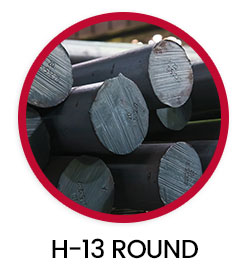
H13 Tool Steel bars and blocks
H13 Tool Steel — India to US
Grade Overview

H13 Tool Steel — X40CrMoV5

H13 is one of the most widely used hot-work tool steels across industries. It is a high-alloyed Cr-Mo-V steel known for excellent resistance to thermal shock, heat checking, and wear, combined with outstanding mechanical strength and toughness under high temperatures. Its composition—roughly 0.4% carbon, 5% chromium, 1.3% molybdenum, and 1% vanadium—enhances its ability to withstand high heat and mechanical stress.

H13 also provides reliable machinability and maintains hardness throughout processing. Typically supplied in annealed condition; also available pre-hardened (460–500 BHN).

ESR Variant

ESR (Electro Slag Refined) H13

ESR H13 offers enhanced toughness and superior micro-cleanliness compared to standard VD grades. Highly recommended for aluminum pressure die casting and extreme thermal/pressure conditions. All ESR H13 bars are 100% ultrasonic tested and meet NDT standards.

Chemical Composition

H13 Chemical Composition (%)

CSiMnPSCrMoV
0.32 - 0.450.80 - 1.250.20 - 0.600.03 max0.03 max4.75 - 5.501.10 - 1.750.80 - 1.20
Properties

Mechanical & Physical Properties

Mechanical Properties

Tensile Strength1550–2050 MPa
Yield Strength1000–1380 MPa
Elongation10–15%
Impact Toughness20–40 J/cm²
Hardness45–52 HRC
Compressive Strength2550 MPa
Elastic Modulus215 GPa

Thermal Expansion

Temperature RangeCoefficient
20–100°C10.8 × 10⁻² m/(m·K)
20–210°C12.0 × 10⁻² m/(m·K)
20–300°C12.4 × 10⁻² m/(m·K)
20–400°C12.7 × 10⁻² m/(m·K)
20–500°C13.1 × 10⁻² m/(m·K)
20–600°C13.3 × 10⁻² m/(m·K)
20–700°C13.5 × 10⁻² m/(m·K)

Thermal Conductivity

Temperature20°C350°C700°C
W/(m·K) Annealed27.130.433.2
W/(m·K) Quenched & Tempered25.427.730.4
Heat Treatment

Heat Treatment & Processes

Proper heat treatment ensures H13 achieves optimal hot hardness, toughness, and thermal fatigue resistance.

ProcessTemperatureCoolingResult
Soft Annealing760–810°CFurnaceMax 240 HB
Stress-Relief Annealing610–660°CFurnace
Hardening1030–1060°CAir, oil, or salt bath (500–550°C)55 HRC

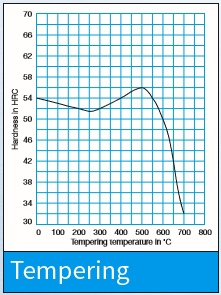
Tempering Chart (after quenching)

Temp °C100210300400500550600650700
HRC545353555654514334
Hardening Process

Preheat to 816°C (1500°F), then raise to 1010°C (1850°F) for 15–40 minutes before air quenching. H13 has high hardenability and should be cooled in still air. For decarburization control, use salt bath or pack hardening in coke.

Tempering & Quenching

After quenching, temper at 500–650°C for 1–2 hours per cycle. Double tempering recommended; triple tempering for large sections. Quench rapidly in air, oil, or polymer medium.

Forging & Nitriding

Forging: Heat evenly to 1040–1095°C (1900–2000°F), reheat as necessary, stop forging below 900°C (1650°F). Cool slowly in furnace or dry ash. Always anneal post-forging.

Nitriding: Enhances surface hardness (1000–1250 HV) and corrosion resistance at 525°C post-hardening. ESR variant recommended for critical applications.

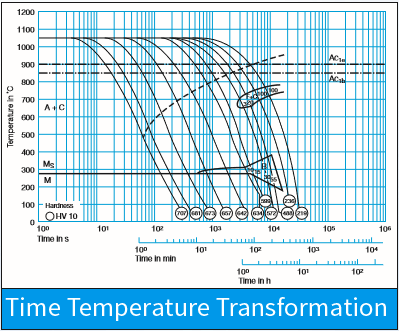
H13 Steel tempering curve and microstructure
H13 Steel property diagram
Applications

Typical Applications for H13

Available Forms

H13 Mode of Supply

H13 tool steel is supplied in round bars of all standard and custom sizes.

H13 steel round barsRounds
Interested in H13?

Let’s Discuss Your Application.

Tell us the application, required properties, and quantities. We’ll confirm supply capability and walk you through our process.